

Determining the identity of an unknown plastic is a common challenge across the product lifecycle. A manufacturer may have a legacy component with incomplete documentation, a product designer may need to match or replicate the material properties of an existing part, or an engineer investigating a field failure may need to verify that the correct resin was used during production. Similarly, maintenance personnel, procurement teams, and reverse engineering specialists frequently encounter plastic components whose material specifications are unavailable or uncertain.
Accurate material identification is also essential when sourcing replacement materials, selecting compatible adhesives, coatings, or solvents, validating chemical resistance, or determining appropriate recycling and end-of-life processing methods. Because different polymers can exhibit similar appearance while possessing significantly different mechanical, thermal, and chemical properties, visual inspection alone is rarely sufficient. Establishing the identity of the plastic provides the foundation for informed engineering decisions, reducing the risk of material incompatibility, premature failure, unnecessary testing, and costly design or manufacturing errors.
Identifying unknown plastic can often be done using simple field tests that don’t require specialized lab equipment. These tests can help narrow down the most common plastics, such as ABS, polycarbonate, polypropylene, nylon, PVC, polyethylene, polystyrene, and acrylic. However, for grade-level identification and production-critical applications, professional methods like FTIR spectroscopy and DSC are required.
Five Field Identification Methods for Plastics
To identify an unknown plastic, five simple tests should be conducted in this recommended order:
- Visibility Test — resin code, transparency, surface feel, and flexibility
- Float Test — density separation in water and salt water
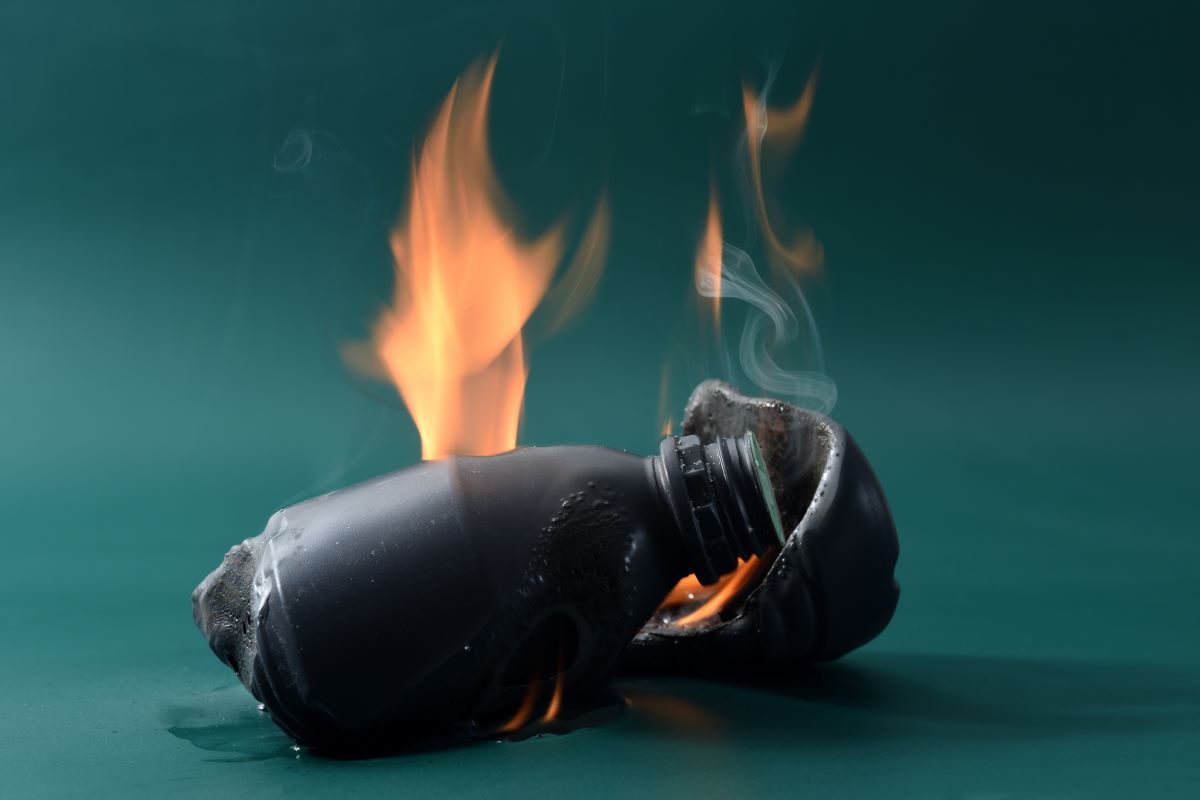
- Burn Test — flame color, odor, smoke, dripping, or self-extinguishing
- Solvent Test — acetone reaction to confirm or eliminate ABS, PS, PC, and acrylic
- Scratch and Sound Test — quick separation of soft vs. rigid resins
This guide outlines each plastic identification method and briefly describes the in-lab techniques available when simple field tests aren’t enough.
How to Identify Unknown Plastics Step-by-Step
Visual and physical inspection should be used first to eliminate multiple material families. This initial step can help point toward the most likely candidates.
The Plastic Resin Identification Code (Recycling Symbol)
The recycling symbol on most consumer plastic products looks like a triangle with a number 1–7. It is the Resin Identification Code (RIC), which indicates what kind of plastic the product is made of. The RIC symbol can usually be found on the underside of the item or inside the part cavity.
| Code | Material | Uses | Characteristics |
| 1 | PET | Water bottles, food trays | Clear, stiff, lightweight |
| 2 | HDPE | Milk jugs, pipe fittings | Tough, chemical-resistant |
| 3 | PVC | Pipes, cable insulation | Releases HCI gas when burned |
| 4 | LDPE | Squeeze bottles, bags | Soft, flexible, wavy feel |
| 5 | PP | Food containers, living hinges | Semi-rigid, fatigue-resistant |
| 6 | PS | CD cases, disposable products | Rigid and brittle |
| 7 | Other | Engineering components | Requires further testing |
In some cases, further laboratory testing may be required for an accurate identification.
Identifying Plastic Types by Look, Feel, and Flexibility
The way a plastic looks in light, responds to pressure, and feels under your thumb are all physical properties of the base resin. Work through transparency, surface feel, and flexibility in that order.
- Crystal clear, glass-like: Polycarbonate (PC), acrylic (PMMA), clear PET. PC is rigid with no yellowing; acrylic is similar but more brittle.
- Translucent or milky: PE and PP in thin sections. Natural Nylon has a distinctive milky translucence.
- Waxy, slippery feel: PE or PP — low surface energy means paint and adhesives won’t bond without surface treatment.
- Hard with a hollow tap: ABS — the most common resin for enclosures and consumer product housings.
- Dense, near-glass rigidity: PC — noticeably heavier than ABS at the same wall thickness.
- Smooth, slightly waxy, off-white in natural form: Nylon — stiff but not brittle, springy under light load.
- Rubbery or yielding: TPE or TPU — common in overmolded grips, seals, and flexible sections.
The Float Test
Cut or scrape a small sample and drop it into water, then into salt water (120g per liter). If a sample floats in plain water, it is almost certainly PE or PP. If it sinks in plain water but floats in salt water, its density points toward ABS, polystyrene, or certain nylon grades.
However, if your sample sinks in both plain water and salt water, the density likely indicates the sample is polycarbonate, PVC, PET, or acrylic. Combining both tests brackets the density and usually narrows candidates from many possibilities to two or three.
The Burn Test
How to Run the Test
Break a small sample from an edge, rib, or tab, and hold it with metal tongs. Slowly bring it to the edge of a flame, and observe the following in order:
- Does it ignite readily or resist the flame?
- What color is the flame?
- Does the material drip, char, melt, and flow, or form a blackened crust?
- What color and density is the smoke?
- What does it smell like?
- When removed from the flame, does it continue burning or self-extinguish?
Burn Test Results by Material
Polypropylene (PP)
Burns readily and continues after removing the flame. Melts and drips, but the drips may continue burning. Smoke is minimal and clean, and the smell is of paraffin wax or scented candle.
Polyethylene (PE)
Nearly identical to PP in flame and smell, but PE tends to flow and drip more freely than PP. Both produce the clean paraffin smell, and neither produces the harsh smoke of engineering resins. If it floats and smells like a candle, it is PE or PP.
ABS
Burns with a bright yellow flame and produces thick, rolling, sooty black smoke. The odor is sharp, and when burned, it blackens at the edges rather than flowing cleanly and continues burning after removing the flame.
Polystyrene (PS)
Even heavier black smoke than ABS, with visible rolling waves and bright yellow-orange flames. The smell is sweet and slightly floral, often compared to model glue or plastic solvent. Burns freely and continues after you remove the flame.
Polycarbonate (PC)
Burns slowly and reluctantly with a yellow-orange flame that sputters. Black smoke, less dense than ABS or PS. However, the key marker is that it’s self-extinguishing, and the smell is faintly phenolic.
Nylon
Burns slowly with a blue flame tipped in yellow, then melts and drips with relatively little smoke. Nylon self-extinguishes or burns very slowly, but the smell is unmistakably like burning hair or wool.
PVC
PVC resists ignition and self-extinguishes quickly when flame is removed. There is a green tinge in the flame from chlorine and dense dark smoke. The smell is a sharp chlorine or HCl odor. PVC releases chlorine gas and hydrochloric acid vapor when burned, so always conduct a burn test outdoors or in strong ventilation.
Acrylic
Burns with a bright, clear, crackling flame and relatively clean or white smoke. The smell is strongly fruity and sweet, like ripe fruit or certain adhesives. It melts and drips, then continues burning after removal.
The Solvent Test
Apply a single drop of acetone to an inconspicuous area or cut sample. Then, observe the material for 60 seconds in a well-ventilated space. Watch for the following:
- If it dissolves, softens, or clouds within seconds, it’s likely ABS or Polystyrene.
- If the surface crazes or stress-whitens after evaporation, it’s probably polycarbonate.
- If no visible effect occurs, it’s likely PE, PP, Nylon, or PVC.
MEK is a stronger solvent useful for materials that resist acetone. Chlorinated solvents like methylene chloride dissolve PC readily and can help confirm PC vs. acrylic vs. ABS in transparent parts. Only use with proper PPE and ventilation.
Reading the Results
No single plastic identification test can provide a definitive answer. Therefore, cross-examination and observations across tests can help identify the most likely material.
| Material | Float/Sink | Burn Signature | Acetone | Smell |
| PP | Float | Blue/yellow, clean smoke | No effect | Paraffin wax |
| PE | Float | Blue/yellow, waxy drip | No effect | Paraffin wax |
| ABS | Sink | Yellow, black smoke | Dissolves | Sharp, acrid |
| PS | Sink | Yellow-orange, heavy smoke | Dissolves | Sweet, floral |
| PC | Sink | Yellow, self-extinguishing | Crazes | Faintly phenolic |
| Nylon | Sink | Blue/yellow, self-extinguishing | No effect | Burning hair |
| PVC | Sink | Greenish, self-extinguishing | No effect | Chlorine |
| Acrylic | Sink | Clear, light smoke | Dissolves | Sweet, fruity |
Professional Identification Methods
FTIR spectroscopy
Fourier Transform Infrared (FTIR) spectroscopy is the industry standard for plastic identification. It uses a small scraped sample that is exposed to infrared light; the absorption spectrum is matched against a library of thousands of known resins.
The test identifies base resin with high confidence, detects common fillers and additives, and can separate material families that produce ambiguous burn test results.
DSC
Differential Scanning Calorimetry (DSC) measures thermal transitions such as melting point, glass transition temperature, and crystallization behavior. It’s useful for separating semi-crystalline resins, since Nylon PA6 (~220°C) and PA66 (~260°C) have different melting points that DSC separates, whereas burn tests may not.
XRF
X-ray Fluorescence (XRF) testing identifies elemental composition to detect fillers (glass, talc, barium sulfate), metal additives, or restricted substances (lead, cadmium, halogens). It’s a non-destructive plastic identification test that can be run on an intact part without cutting or sampling.
MFI
Once the base resin is identified, the Melt Flow Index (MFI) determines the specific grade. Matching MFI to an available commercial grade is a critical step in selecting an exact replacement resin for production.
However, identifying the material family is only step one. The more consequential question for engineers preparing to replicate or replace a part through injection molding is which grade to specify for production.
This means that operating temperature, impact loads, chemical exposure, regulatory classification, and how the resin will behave in a mold must be fully understood. Protoshop’s Injection Molding Materials Selection Guide is the practical next step for engineers. The guide covers ABS, PC, Nylon, PP, TPE, PEEK, and more with key performance properties including strength, heat resistance, impact resistance, flexibility, and chemical compatibility. It also explains how to connect what you’ve identified in a sample to what you should specify for production.
Contact Protoshop Today
In some cases, the most effective approach for determining the appropriate resin for a plastic part is to fabricate a production-representative mold and manufacture trial components using multiple candidate materials. Evaluating these parts under production-equivalent conditions provides empirical data on performance, enabling informed material selection based on functional, mechanical, and environmental requirements. This is what Protoshop does best.
If you have a physical part and need help identifying the material, validating a match, or selecting a resin for production, Protoshop’s engineering team can help. Contact us directly or browse the Materials Selection Guide to get started.
